

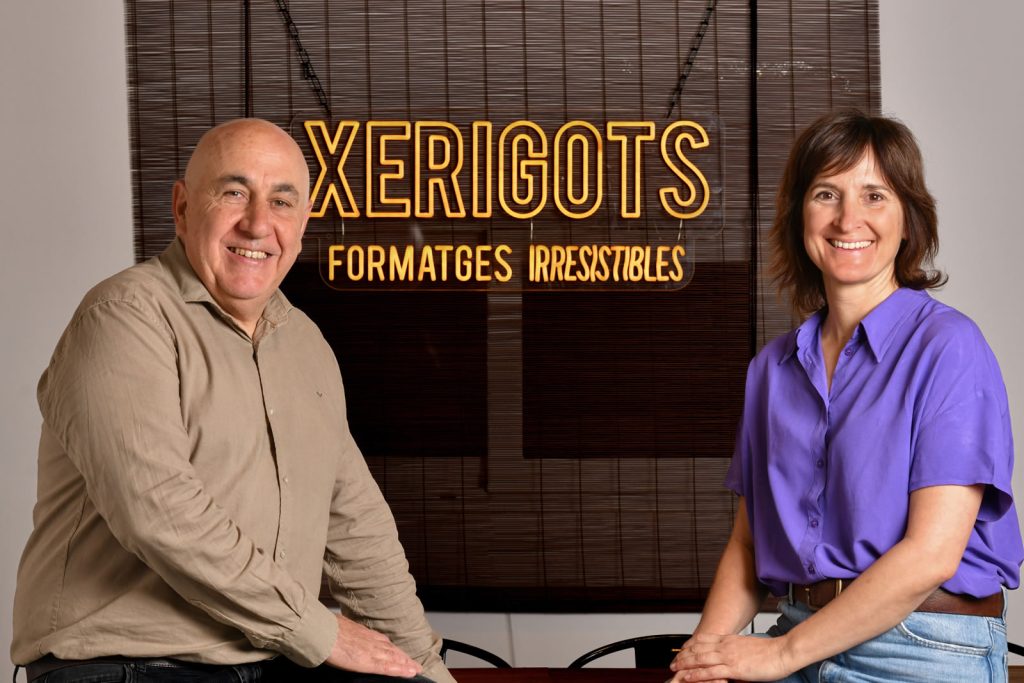
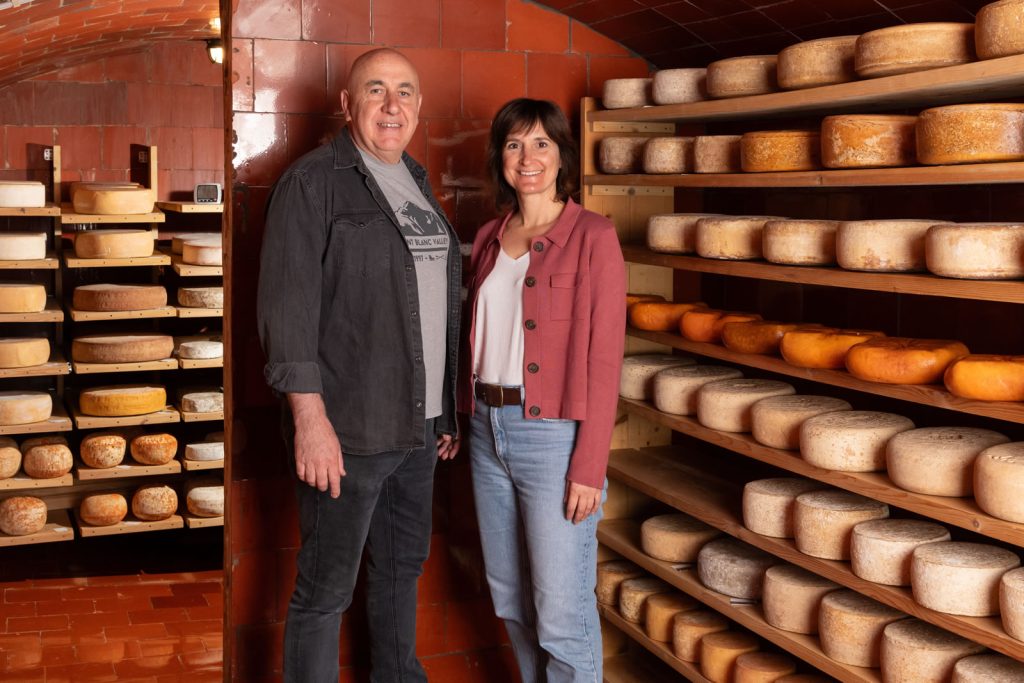
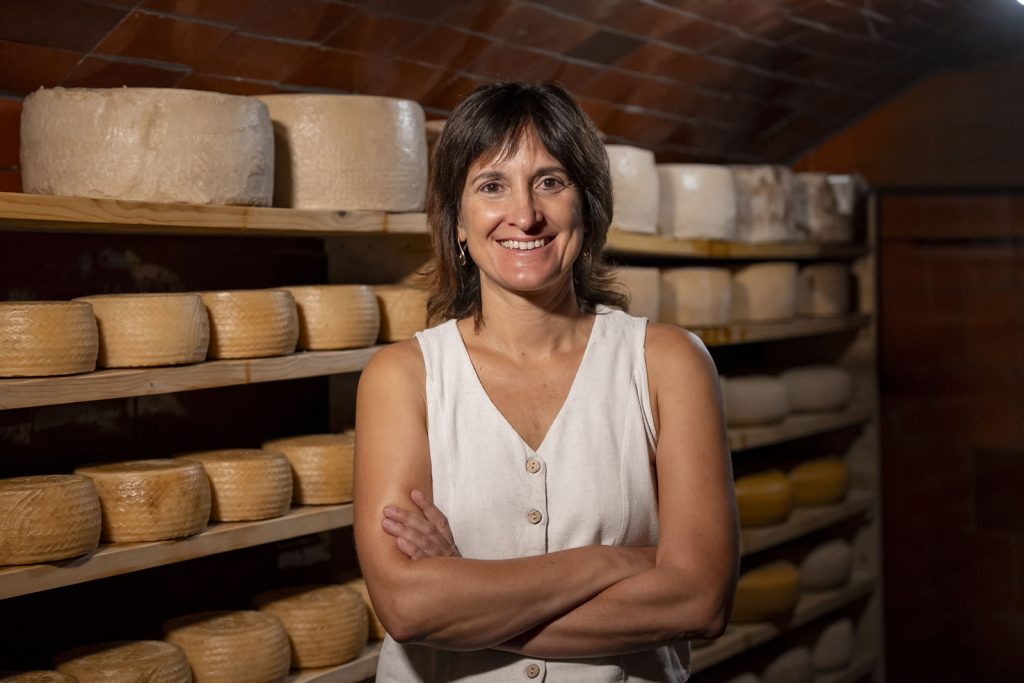
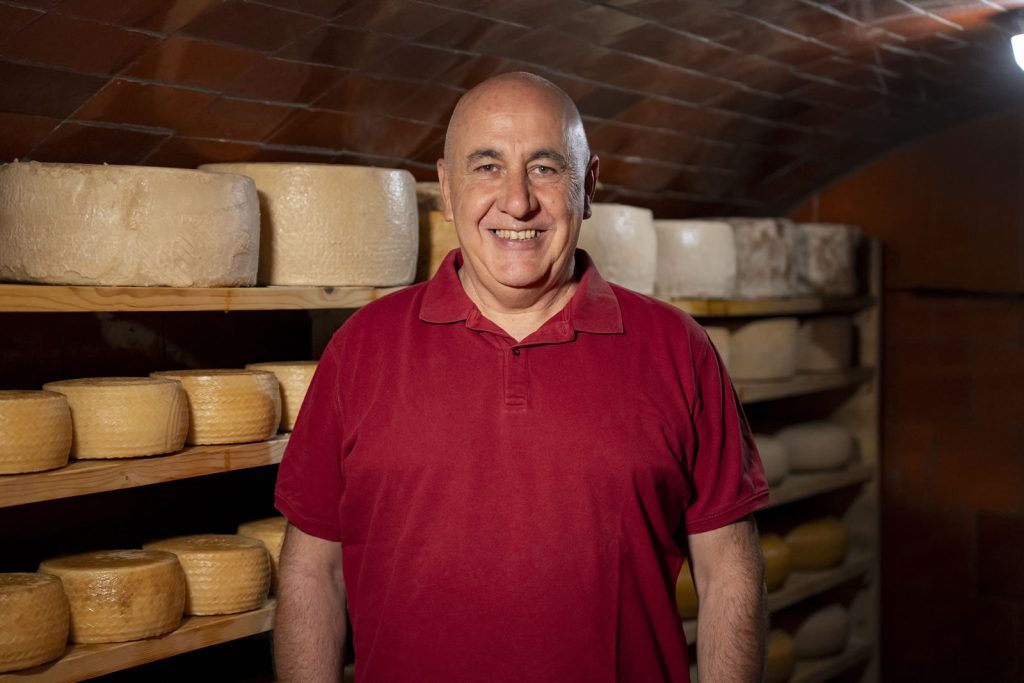

Jordi Bertran and Gemma Urgell have just published the book Formatges. Through their project Xerigots, they have created a place to find good cheese. In this book, they share tips, secrets and irresistible recipes for cheese lovers.
Xerigots was born in 2011 as a shared project. How has your way of understanding cheese evolved after fifteen years?
When we started, artisan cheese was still fairly unknown in our country. Beyond the most classic cheeses, there was little knowledge about the great diversity that exists and, above all, about the artisan cheeses being made in Catalonia. Our aim was to work towards greater consumption and knowledge of artisan cheeses.
Catalonia had a growing and very interesting cheesemaking tradition, but we felt it still did not have enough visibility.
Over these fifteen years, cheese culture has grown. There are more cheese dairies, more projects, more gastronomic curiosity and also more consumers who want to know what they are eating and where it comes from. And we have also seen cheese return to restaurants, where for a while it had been rather sidelined.
We have also evolved with the product: we started with a shop and today we work mainly with the hospitality sector, alongside cheesemakers, chefs and restaurateurs. And this shared perspective has made us understand cheese even more as a gastronomic product, but also as an expression of land and culture.
Would you say Catalonia is going through a good time for artisan cheese? What has changed in recent years?
Yes, without a doubt. Very diverse, high-quality cheeses are being made, and there are artisan cheese dairies doing extraordinary work. There are also more professionals, shops, restaurants and consumers interested in this world.
But precisely because we are in a good moment, the challenge now is to consolidate it. Cheese dairies must be able to keep moving forward, and they need access to milk, to pasture and to the resources that allow them to sustain their activity. Their work also needs to be better valued, and we need to make sure that all cheese dairies can be economically sustainable.
For artisan cheese to have a future, it has to be more present in restaurants, in cheese shops, in other shops and also in large retail. And that means some projects being able to grow and professionalise without losing what makes them special: their artisan character, their connection with the land and the uniqueness of the product.
What will someone who comes to the book without much prior knowledge learn about cheese?
We hope they will discover that cheese is much more than something to serve at the end of a meal or on a piece of toast. It is an extraordinarily versatile product: we can eat it cold or hot, on its own or with something else, in a salad, in a sauce, in a main course or even in a dessert.
But above all we would like them to discover everything that lies behind a cheese: history, land, culture, animals, landscape and people. To understand that there are many types of cheese and many different ways of enjoying them.
And, above all, that the book sparks their curiosity and makes them want to taste, to experiment and to cook with cheese.
In Formatges we find classics such as fondue, raclette and tartiflette, but also contemporary recipes. How did you select the recipes that appear in the book?
At Xerigots we work with chefs and restaurateurs so that they incorporate artisan cheese into their menus and recipes. This constant dialogue with professional kitchens and with cheesemakers has allowed us to understand the product better and explore many of its possibilities.
A large part of the recipes in the book comes precisely from this work and this experience. Some we had already shared on our social media and others were created or adapted especially for the book.
You will also find recipes from restaurants that very generously agreed to share their cooking and adapt it so that we can reproduce it at home. We wanted the book to be a combination of recipes that are part of our cheese culture and others that let us discover new and surprising ways of cooking this product.
We often think that cooking with cheese simply means melting it. What other culinary possibilities does it offer?
Lots! Cheese is probably one of the most versatile foods we have. It can have a place at practically every stage of a meal: as an appetiser, a starter, a first course, a main course and even as a dessert.
We can enjoy it cold, for example in a salad; we can use it to make a sauce, grate it, gratinate it, fry it, add it to a dough or combine it with fruit and sweet products. And we can also play with very interesting contrasts, such as cheese with sweet wine.
One of the things we wanted to convey with the book is precisely this idea: that there is no single way to eat cheese. When you start experimenting, the possibilities are almost endless.
What role do you think restaurants and chefs play in spreading and consolidating cheese culture?
It is fundamental. Chefs are great influencers and they have the ability to introduce a product to their customers in a very natural way: through the pleasure of eating.
When a restaurant puts a good cheese on its menu, explains where it comes from and who makes it, or suggests a different way of eating it, it is spreading knowledge. And often the customer who tries it then wants to know more, looks for it in a shop or wants to take some home.
That is why we believe the future of artisan cheese also depends on the bond between cheesemakers and chefs. We have learned a lot working with restaurants and, at the same time, we like to think that we also help them discover new cheeses and bring them into their cooking.
You talk about cheese as a living product, full of culture, history and emotion. What lies behind a good cheese that consumers often never get to see?
Behind a piece of cheese there are many hours of work and, above all, work that never stops. There are people who look after a herd, who milk the animals, who transform that milk, who make the cheese and who then care for it during ripening.
And all of that happens every day. Animals know nothing of weekends or holidays; they have to be looked after every day. That is why we say it takes enormous dedication, which is sometimes little recognised or valued.
It is craft work that requires knowledge, patience, vocation and also a good dose of creativity. And then there is the land: the pastures, the climate, the milk, the traditions and each cheesemaker’s way of doing things. All of that ends up inside a piece of cheese.
Perhaps that is why we say it is a living product: because it keeps evolving and because it tells us much more than what we see when it is in front of us.
After reading Formatges, how would you like readers to look at cheese the next time they walk into a cheese shop or open the fridge to make dinner?
We would like to have sparked their curiosity. For them to be more eager to learn, to taste, to try different cheeses and, above all, to cook with them.
That when faced with a cheese they do not just think “this is for a cheese board”, but ask themselves: what can I do with it? What can I pair it with? How can I cook it?
And we would also like them to look at cheese with a little more respect and awareness: knowing that behind that piece there are people, animals, land and many hours of work.
In short, that after reading the book they become a little more of a cheese fan and discover that, once you enter this world, there is always a new cheese to taste and a new way to enjoy it.


