Did you always know you wanted to be a baker?
No, it was after finishing my History degree at the Universitat de les Illes Balears that I enrolled on a vocational course in baking and pastry at the Institut Sureda i Blanes. A few years earlier I had started teaching myself the trade, using recipes from books and videos on the internet, which I then put into practice.
How did your interest in ancient wheat grains come about?
As a historian I have always liked researching the past, but I have also loved the world of farming; if we don’t bring it to life, it will be reduced to history. That is where my interest in ancient wheats comes from: giving farming a present and a future.
One of the ancient wheats you champion is blat mollar. Does it have an interesting history?
It certainly does! In Mallorca it has only been known since 1848. It is a grain of unknown origin. The story goes that it sprouted by chance on a terrace wall belonging to a farmer from Calvià who lived in Galilea (municipality of Puigpunyent), called Pere Joan Vicens, nicknamed Mollar. Since he found the grain was good, he propagated it. After sowing it on a large scale, the result was so splendid that the new variety, named after its discoverer, quickly spread across the whole island. In 1857, at the agricultural exhibition in Madrid, it was highly praised, and one of its exhibitors, Jaume d’Olesa, won the gold medal with what he grew on his land. And so it spread more and more, until it was pushed aside by today’s transgenic wheats
What other type of ancient wheat do you usually use?
Above all I use xeixa wheat for savoury baking, such as panades, cocarrois and coques, but I also use it for bread every day, mixed with other wheats.
How would you rate these first months of the shop?
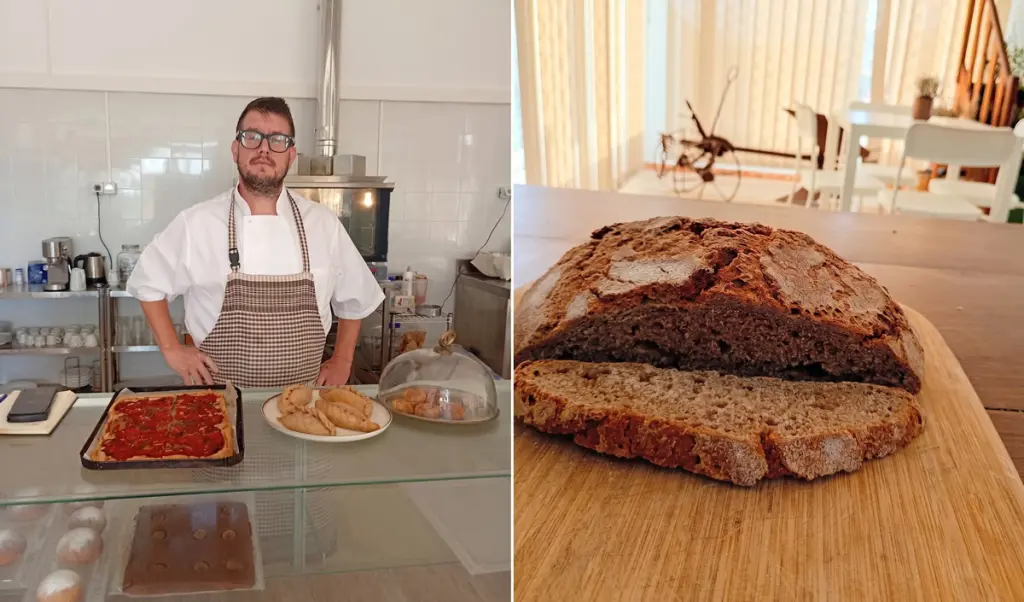
After a long administrative process, I was able to open the shop, which also houses the bakehouse, on 19 June. Emotionally, my assessment of these first two months is positive, because I am doing what I love and helping Mallorca’s farmers, since I buy the raw materials for my products from them.
What do you offer?
You can find different types of bread and other products. Among the traditional ones there are panades, cocarrois and quartos.
You also focus on low-sugar pastries. Why?
I have a line of sugar-free pastries; for example, I make a brownie with seasonal fruit: right now I make one with figs and another with banana, made with wholemeal spelt flour (a hulled wheat). Traditional baking, on the other hand, I make with sugar, such as cremadillos or coques de patata. Sugar isn’t bad; what is unhealthy is overdoing it. Eating industrial pastries isn’t good either because, as well as containing a lot of sugar, they contain lots of additives.
What products do you make?
Every day I make all kinds of bread (xeixa, rye, spelt, brioche, oat, kamut), and I also make cremadillos in different flavours (chocolate, custard, jam, cabell d’àngel (angel hair), among others ), panades, cocarrois, mini panades of sobrassada with honey, vegetable coques, and more.
Is there anything else you would like to add?
Anyone looking for good bread made with artisan sourdough is invited to come and see me (Camí de Can Frontera, 22), where they can try it. I also encourage anyone who wants to start a local business to go for it without fear, because -beyond social media- the present and the future is and will be local.
“The present and future of farming depend on bringing old varieties such as blat mollar and xeixa wheat back to life”
Baker and historian Lluc Munar has opened an artisan bakehouse in Pla de na Tesa, where he makes breads and traditional pastries with native grains