

The Federació Avícola Catalana (FAC) has promoted a comprehensive study on egg consumption in Catalonia to find out how consumers perceive where this food comes from, its values and the role it plays in their diet.
Coinciding with World Egg Day, which is celebrated on 10 October, the study aims to provide data that can close the gap between what consumers value (proximity and quality) and what they actually know about where their eggs come from, with the further aim of highlighting a local product that is healthy and highly nutritious.
The initiative is particularly significant this year, as Catalonia holds the title of World Region of Gastronomy, an award granted by IGCAT (International Institute of Gastronomy, Culture, Arts and Tourism). The title aims to promote regions that actively contribute to improving people’s quality of life, highlighting different food cultures, education for health and sustainability, and gastronomic innovation.
The Federació Avícola Catalana (FAC) study reveals a clear consumer preference. A resounding 81% of Catalans (8 out of 10) choose locally produced eggs, basing their choice on three key reasons: freshness, support for the local economy and sustainability.
Based on the conclusions of the study, which gathered the opinions of 1,000 citizens, a range of informative resources has been created. Under the slogan ‘Tria ous amb accént català’, these materials aim to encourage the consumption of Catalan produce and help consumers make more conscious and informed purchases.
The data gathered show that freshness is particularly important, as it is directly linked to proximity: an egg from a nearby farm means a shorter distance and therefore less time since laying, which helps preserve its nutritional value, maintain its organoleptic properties and extend its shelf life.
According to those surveyed, choosing locally produced eggs also means supporting the local economy, as it fosters job creation in the primary sector and ensures that profits are reinvested in the community. It also helps balance the territory, supporting the continuity of traditional economic activities and helping to keep food traditions alive. In this way, it encourages consumption that is more sustainable and better for the environment.
The study also notes that 68% of respondents believe the eggs they eat are from Catalonia, although 28% say they do not know where they really come from. Most (81%) remember seeing a code on the eggshell that provides information, but 25% of consumers admit they do not know what it means and 79% find it hard to interpret. For example, 84% acknowledge that they could not tell whether the egg they buy comes from Catalonia just by looking at the code.
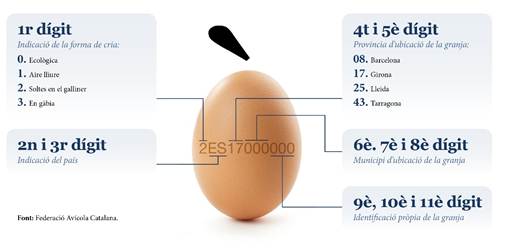
What does the code on the eggshell mean?
“The code printed on the shell is an essential tool for consumers. It provides key, transparent information about the product they are buying, beyond whatever may appear on the box or in advertising. We know that proximity is an important factor for 81% of Catalans and it is therefore our responsibility to give them the knowledge they need to choose consciously. This initiative seeks precisely to connect what consumers value with what they actually know”, says Joan Anton Rafecas, president of the FAC.
What does the code mean?
The egg code is the series of numbers and letters printed on the shell. It makes the egg traceable, as it identifies the farm it comes from. Its digits provide different details about the egg’s origin, telling us everything from how the laying hen was raised to where the egg comes from.
The egg was a pioneer in food traceability, becoming one of the first foods to carry a compulsory printed code on its shell.
A growing trend to eat more eggs, including at breakfast
According to the FAC study, egg consumption is widespread, reaching almost all Catalans. As for frequency, 60% eat eggs 2 to 3 times a week, 23% eat them once a week and 9% eat them every day. Women and older people eat them more often than younger men.
Even so, respondents are aware that eating eggs is healthy and feel they could eat more. In fact, 30% of respondents believe the ideal weekly amount should be between 4 and 5 eggs.